The Operating Cadence That Keeps a Scaling Company Coherent
Most companies do not lose alignment through disagreement. They lose it to drift, because nothing forces the whole company to look at reality together.
In one quarter we discovered that sales was promising a feature that engineering had deprioritised, marketing was running campaigns for a segment we had decided to stop serving, and finance was modelling headcount nobody intended to hire.
Nobody had gone rogue. Every one of those teams was executing a plan that had been correct about ten weeks earlier. The plan had changed. The information had not travelled.
That is what drift looks like, and in my experience it is almost never caused by disagreement. It is caused by the absence of a forcing function: a moment in the calendar where everyone has to look at the same reality at the same time and say out loud what they are doing about it.
What a cadence actually is
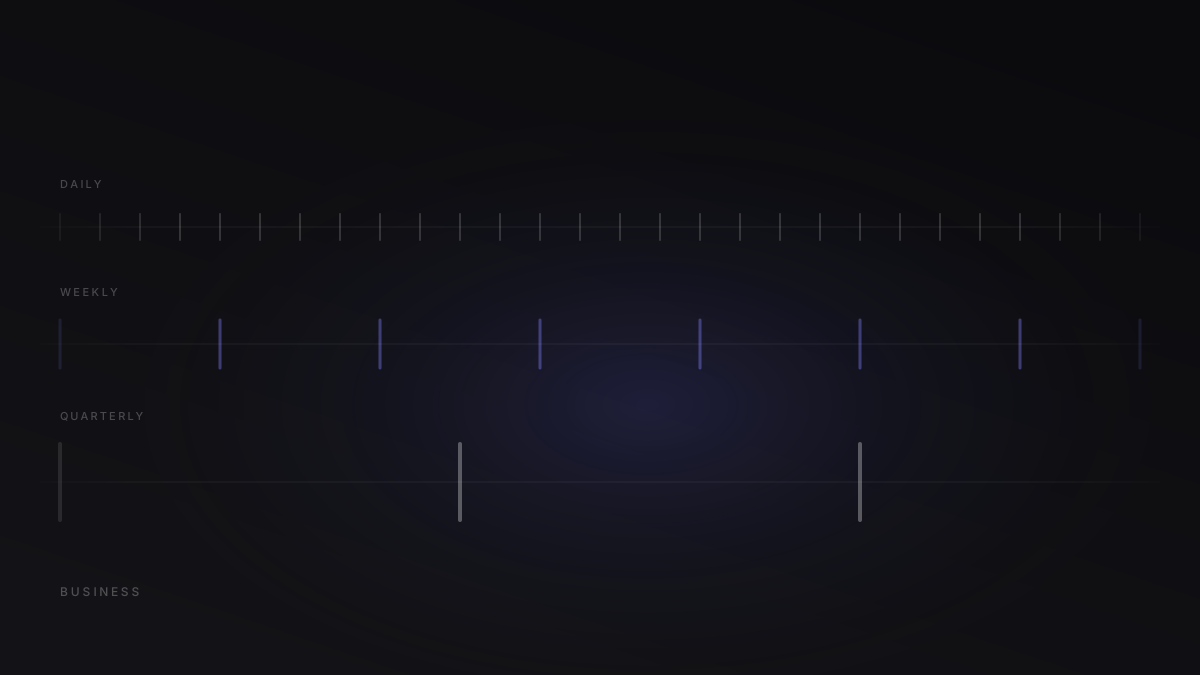
An operating cadence is a small set of recurring meetings, each with a different time horizon, each answering a different question. Together they form a loop: decide, execute, observe, correct.
Most companies have meetings. Fewer have a cadence. The difference is that in a cadence, each meeting has one job, and no meeting does another meeting's job.
None of this is my invention. Andy Grove laid out the idea in High Output Management in 1983, describing how Intel ran on regularly scheduled "process-oriented" meetings (the one-on-one, the staff meeting and the operation review), separate from the "mission-oriented" meetings called to solve one specific problem. Grove estimated that routine meetings, run well, take care of maybe 80 percent of a company's problems and issues before they need special attention.
The failure mode is a single weekly leadership meeting where quarterly strategy, this week's blocked deal and a customer escalation all compete for the same hour. Urgency always wins. Strategy gets discussed for six minutes at the end, every week, forever.
Most managers know this feeling. Senior managers spend, by some estimates, nearly 23 hours a week in meetings. When Leslie Perlow and colleagues surveyed 182 senior managers for Harvard Business Review, 71 percent said meetings are unproductive and inefficient, and 65 percent said meetings keep them from completing their own work. The answer is not fewer meetings in the abstract. It is meetings that each do one job well, because Rogelberg's research found that how effective people judge their meetings to be has a strong, direct relationship with their job attitudes and well-being. Bad meetings do more damage than the hour they take.
The four layers
Weekly: what is blocked
Thirty minutes, same time every week, each team. One question: what is stopping us, and who is unblocking it.
Not a status report. Status belongs in writing, circulated beforehand. If people are reading updates aloud, you are using the most expensive coordination mechanism you have to transmit information that a document transmits better.
Every item leaves with a name and a date. No name, not an item.
Monthly: what the numbers say
Ninety minutes. Leadership plus function heads. The point is to look at actuals against what you expected, and to say what you are doing about the gaps.
The discipline that makes this work is publishing the numbers 24 hours in advance and expecting everyone to arrive having read them. The meeting is for interpretation and decision, not for presentation. We banned walkthrough decks and the meeting got roughly forty percent shorter and considerably more useful.
Five to seven metrics. If you have thirty, you have none. Nobody can hold thirty numbers in mind well enough to notice when one is behaving strangely.
Quarterly: what we are choosing
Half a day. This is where you set three to five priorities for the next twelve weeks and explicitly name what you are not doing.
The "not doing" list is the part most teams skip, and it is the part that makes the exercise real. A priority list without a stop list is a wish list, and it produces the exact situation I opened with: teams executing plans that were quietly superseded.
Each priority gets one accountable owner and a measurable definition of done. "Improve onboarding" is not a priority. "Reduce median time-to-first-value from 11 days to 5" is.
If this sounds like OKRs, it is close. Google's own guide to OKRs, a practice John Doerr brought to Google from Andy Grove's Intel, gives the same two rules: pick just three to five objectives, because more spreads effort too thin, and write key results that describe outcomes, not activities.
Annually: what we believe
One or two days. The market, the bet, the shape of the company in eighteen months, the resourcing that implies.
The annual plan will be wrong in detail. That is fine. Its value is that it makes the assumptions explicit enough to notice when they break. An assumption nobody wrote down cannot be falsified, so nobody ever updates it.
The rules that make it work
The structure is common knowledge. These are the parts that determine whether it functions or becomes theatre.
- Never move the recurring slots. The moment the monthly review gets rescheduled because something urgent came up, you have taught everyone it is optional. Ours has moved twice in three years.
- Written inputs, circulated in advance. Documents, not decks. Decks let you hide a weak argument behind good design; a document exposes it in the second paragraph. Amazon is the best-known example: in the 2017 letter to shareholders, Jeff Bezos wrote that Amazon does not do PowerPoint presentations, but narratively structured six-page memos read silently at the start of each meeting. Amazon reads in the room rather than the day before; I prefer the day before, so the meeting starts with questions. Either way, the writing is where the thinking gets tested.
- One owner per item, always a person. Teams do work. People are accountable.
- Decisions written down within 24 hours. What we decided, who decided, what would change our mind. The last part is what makes a decision reviewable rather than defensible. Software engineers formalised this years ago as architecture decision records, because, as Michael Nygard put it, one of the hardest things to track over time is the motivation behind a decision. Grove asked the same of meeting minutes: say what is to be done, who is to do it, and when.
- End every meeting with the actions read back. Sixty seconds. It catches the surprisingly common case where two people left with different understandings of what was agreed. In Microsoft's 2023 Work Trend Index survey of 31,000 workers, unclear next steps at the end of a meeting were a complaint for 55 percent, and inefficient meetings were named the number one disruptor of productivity.
- Cancel anything without a decision to make. A meeting that only transmits information should be a document. This is a deliberate departure from Grove, whose process meetings existed partly to share information. In 1983 a meeting was the fastest way to move information around a company. In a company that writes things down, it is the slowest and most expensive.
What this costs
Real hours, and it is worth being honest about them. For a 60-person company, by my own estimate, the full cadence consumes roughly 3 to 4 percent of total working time once you count the preparation as well as the meetings, and the load per person falls heaviest on leadership.
That is a genuine cost. It buys you the ability to change direction in weeks rather than quarters, which in my experience is worth several times the meeting time. Most of the waste in a scaling company is not slow work, it is work that was pointed in a direction the company had already abandoned.
The cost only becomes unreasonable when the cadence stops producing decisions. A meeting that generates no decisions and no changes for two consecutive months should be deleted rather than defended.
Signs yours is broken
- The same item appears on the blocked list four weeks running. That is not a block, it is a decision nobody is willing to make.
- People hold pre-meetings to align before the real meeting. The real meeting is not safe.
- Quarterly priorities get quietly dropped without a conversation. There is no review, or the review is not honest.
- Bad news arrives late and informally. This is the most serious one. If a metric has been declining for six weeks and the monthly review is the first anyone hears of it, the problem is not the cadence; it is what happens to people who report bad news.
That last point has fifty years of research behind it. In the early 1970s the psychologists Sidney Rosen and Abraham Tesser showed experimentally that bad news is transmitted less completely and less spontaneously than good news, something they called the MUM effect. Elizabeth Morrison and Frances Milliken later named the organisational version "organizational silence": powerful forces in many organisations that cause employees to withhold information about problems, held in place by a shared belief that speaking up is unwise. When Milliken and colleagues interviewed 40 employees, most had been in situations where they were worried about an issue and did not raise it with a supervisor; the most common reason was fear of being viewed or labelled negatively. A cadence gives bad news a scheduled place to land. Only leaders can make it safe to land there.
Where to start
If you have nothing, do not build all four layers at once. Start with monthly.
Pick five numbers. Publish them 24 hours before. Meet for ninety minutes with one question on the agenda: where did reality differ from what we expected, and what are we changing. Write the decisions down and send them the same day.
Do that for three months without moving the date once. It will surface more than any reorganisation you were considering. And it will tell you fairly quickly which parts of your company are running on evidence and which are running on momentum.
Sources
- Grove, A. S. (1983). High Output Management. Random House. Chapter on meetings (process-oriented and mission-oriented meetings).
- Rogelberg, S. G., Scott, C. and Kello, J. (2007). The Science and Fiction of Meetings. MIT Sloan Management Review, Winter 2007.
- Perlow, L. A., Hadley, C. N. and Eun, E. (2017). Stop the Meeting Madness. Harvard Business Review, July–August 2017.
- Rogelberg, S. G., Leach, D. J., Warr, P. B. and Burnfield, J. L. (2006). "Not another meeting!" Are meeting time demands related to employee well-being? Journal of Applied Psychology 91(1), 83–96.
- Google re:Work. Set goals with OKRs.
- Bezos, J. (2018). 2017 Letter to Shareholders. Amazon.
- Nygard, M. (15 November 2011). Documenting Architecture Decisions. Cognitect.
- Microsoft (2023). Work Trend Index: Will AI Fix Work?
- Rosen, S. and Tesser, A. (1972). Fear of Negative Evaluation and the Reluctance to Transmit Bad News. Journal of Communication 22(2), 124–141.
- Morrison, E. W. and Milliken, F. J. (2000). Organizational Silence: A Barrier to Change and Development in a Pluralistic World. Academy of Management Review 25(4), 706–725.
- Milliken, F. J., Morrison, E. W. and Hewlin, P. F. (2003). An Exploratory Study of Employee Silence. Journal of Management Studies 40(6), 1453–1476.
Filed under
- Operations
- Business
- Planning
- Meetings
- Execution